


古法琉璃龍鳳對杯–龍鳳各居一半一,龍為升龍,張口旋身,昂首望風。鳳為翔鳳,展翅翹尾,舉目眺龍,周圍瑞雲朶朶,氣氛祥和。
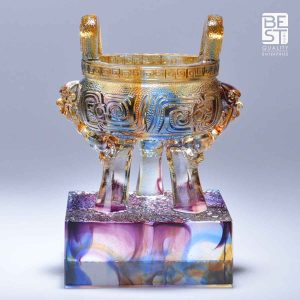
Liuli is known as one of the Seven Treasures of Buddhism, and it is also known as one of China’s five famous artifacts.
In ancient Chinese artificial colored glaze, the main component of the surface enamel is lead barium glass, so it is not suitable for making eating utensils. It is usually used for commonly used decorations/rituals and funeral items. Among them, ancient buildings and modern Chinese buildings are also important decorative components. Since ancient times, Liuli has inherited profound cultural connotations and mythological colors.
The modern production of colored glaze is mainly based on the dewaxing casting method. The whole process has experienced 47 tedious tasks, some of which are hand-processed and calcined in a high-temperature furnace of more than 1,000 degrees for at least seven days. Among them, the difficulty of controlling the temperature can be said to be half by skill. Half by luck. Its colors are flowing clouds and vivid, beautiful; to make the quality crystal clear and dazzling.


 English (UK)
  香港中文
香港中文  简体中文
简体中文